Electronic Cargo Tracking
An article to demonstrate how complex technical problems can be presented in simple language. The customs of East African Countries sought a solution to their perennial problems, and the electronic cargo tracking system was eventually implemented.
Electronic Cargo Tracking: Improving Revenue Collection in Regional Customs Unions
Summary
Every year, billions of shillings are lost because of transit cargo being diverted, tampered with, or delayed. In a regional customs union, relying on traditional control methods like physical escorts and manual inspections can be expensive and face challenges as trade volume continues to grow.
Electronic cargo tracking offers a practical solution to this challenge. Integrating tamper-proof seals with real-time monitoring creates a reliable system that keeps everything secure. This setup helps customs authorities shift from constant monitoring to focusing on specific concerns, intervening only when certain risks are detected, making the process more efficient and reassuring.
Ultimately, electronic cargo tracking helps safeguard revenue, eases border congestion, and makes transit along important corridors more predictable. When it's implemented with shared standards, transparent governance, and common data, it builds trust among member states and enhances both effective control and smoother trade.
- The Transit Challenge in a Regional Context
Up to 30% of the cargo declared in transit ends up in the Kenyan market without paying duties. Traditional methods, such as police escorts and manual checks, are never sufficient and cause significant delays in cargo movement.
Transit volumes are growing alongside the GDP of EAC countries, and with them, revenue losses.
This is where electronic cargo tracking comes in.
- The Concept of Electronic Cargo Tracking
An electronic seal is affixed to a cargo unit or vehicle at the point of dispatch and remains active throughout the authorised transit route, which is defined as a geofence (Fig.1).
Electronic cargo tracking replaces manual checks with physical sealing combined with continuous electronic monitoring. Customs now only intervene if there is tampering with the seal, deviation from the pre-set route, or an unauthorised stop.
This exception-based enforcement approach allows compliant cargo to move freely while early detection of violations ensures compliance. Both control and facilitation objectives are served.
- Operational and Technical Results
The introduction of an electronic cargo tracking system (ECTS) delivers tangible improvements in both operational control and trade facilitation. Additionally, it is supported by reliable, real-time data.
Enhanced Revenue Protection
The system detects diversion, unauthorised unloading, and route deviation, and promptly alerts customs authorities. Electronic seals provide reliable, auditable proof of compliance, ensuring fair and legally sound enforcement.
Improved Transit Predictability and Throughput
Now that manual checkpoints are gone, border crossings are much quicker and less crowded. This means your transit times are more dependable, the roads can handle more traffic, and planning logistics gets easier. All these improvements help trade grow steadily over time.
Risk-Based Enforcement and Targeting
Alerts are activated only when the set conditions are met, ensuring timely notifications. Customs authorities can handle larger transit volumes more efficiently, without needing a proportional increase in staff, which helps cut operational costs and keeps compliance high.
Transparency and Trust Between Administrations
Standardised tracking creates a shared understanding among regional customs authorities. Time-stamped, auditable data boosts mutual trust and reduces disagreements between member states.
- System Components and Standards
An ECTS includes compatible technical and organisational parts. It does not depend on any single device. Instead, it relies on following common standards and well-defined interfaces.
Electronic Seals and Tracking Devices
Electronic seals combine physical sealing with electronic monitoring. Once affixed, they can detect attempts to open, tamper with, or remove them, and send alerts to the monitoring platform.
Location data is transmitted through GPRS. The battery capacity is designed to exceed the maximum expected transit time.
Most importantly, seals work completely on their own. They require no support from vehicle systems or the driver.
The frequency of connections directly impacts battery life. Also, network availability and tamper resistance define the design space.
Communication and Monitoring Platform
Data from electronic seals is transmitted to a centralised monitoring platform that aggregates, analyses, and visualises movements in real time

Fig.1. Geofence
- Business rules help spot exceptions such as route deviations, long stops, or seal tampering (Fig.2. Deviation).
- Access controls make sure each customs authority can see only the data they need.
- Every event is time-stamped and logged.
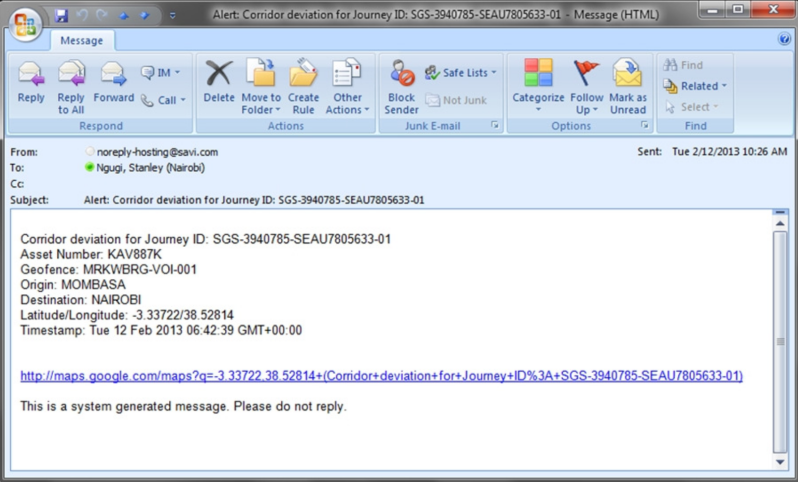
Fig.2. Message about deviation from geofence
Interoperability and Standards
Interoperability is crucial within a regional customs union. ECTS must follow recognised standards for electronic seals, data formats, and communication protocols.
Security and Data Integrity
Security is maintained through a combination of physical and digital measures. Seals are designed to withstand tampering and to log any interference attempts. Meanwhile, digital safeguards operate in the background to protect data during transmission and storage. Records and alerts stay unaltered and trustworthy, ensuring information remains secure.
These combined establish a system that offers evidence you can trust, verify, and use for administrative and legal purposes.
Standards
Two standards are relevant here.
ISO 17712 – Mechanical security & tamper resistance
Many “smart” seals fail because they concentrate on electronics but are mechanically weak or easy to bypass without visible damage.
ISO 18185 – Electronic seals. It defines how an electronic seal authenticates itself, communicates, how tamper events are detected and reported, and how systems should interpret those events. Crucially, ISO 18185 focuses on interoperability and trust, not on features.
Standards-first vendors like Savi Technologies illustrate what this looks like in practice: seals that report not just whether tampering occurred, but what, when, and whether integrity was permanently lost. If a customs authority cannot trust or verify a seal's data, the entire enforcement chain collapses.
- Seal Handling and Operational Logistics
Seal Lifecycle Management
Electronic seals are issued at ports or borders, linked to declarations, vehicles, and an approved route. They are removed at destinations, creating a complete audit trail.
Logistics, Storage, and Maintenance
Seals are stored, transported, and maintained under controlled conditions to ensure the custody chain. Centralised inventory tracking aids demand forecasting, redistribution, and reuse.
Cost and Responsibility Allocation
Responsibilities are clearly assigned to stakeholders, including private service providers. The system's sustainability relies on a cost-recovery mechanism that does not distort trade flows.
- Governance, Oversight, and Coordination
Effective governance depends on a clear separation between customs authorities, who handle enforcement, and technical operators, who oversee system availability and data integrity. In a customs union, it’s vital to establish shared rules on seal usage, alert thresholds, data sharing, and enforcement actions to ensure smooth operation. The system functions within existing customs and transit laws, guaranteeing consistent, legally sound enforcement and fostering trust and reliability.
Conclusion: Control and Facilitation in Balance
At its core, electronic cargo tracking is all about making border security and trade more efficient. It transforms a complicated, manual task into a smooth, dependable process. When you support this technology with clear rules and global standards, you're not just safeguarding revenue, but also creating a quicker, more trustworthy trade network that benefits everyone involved.